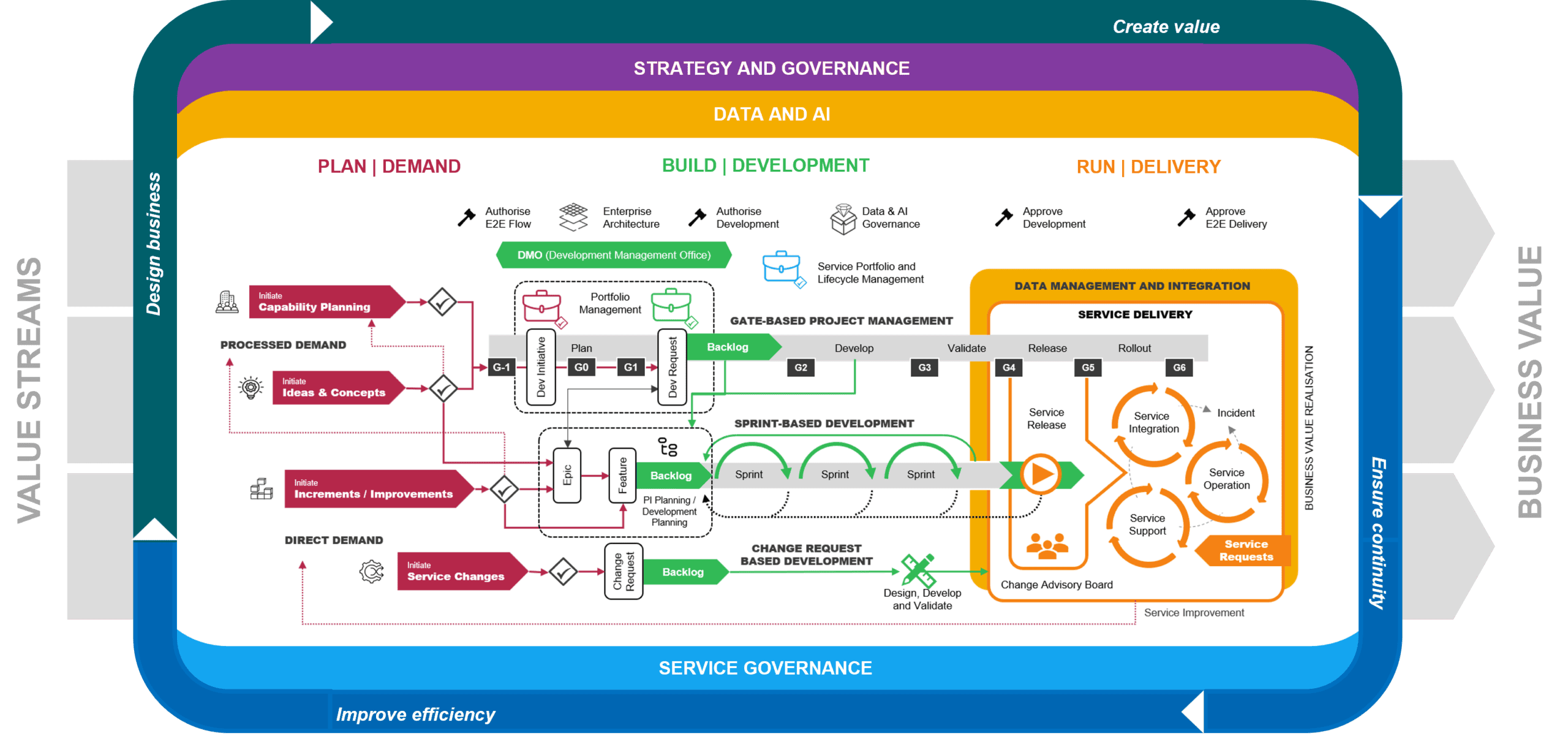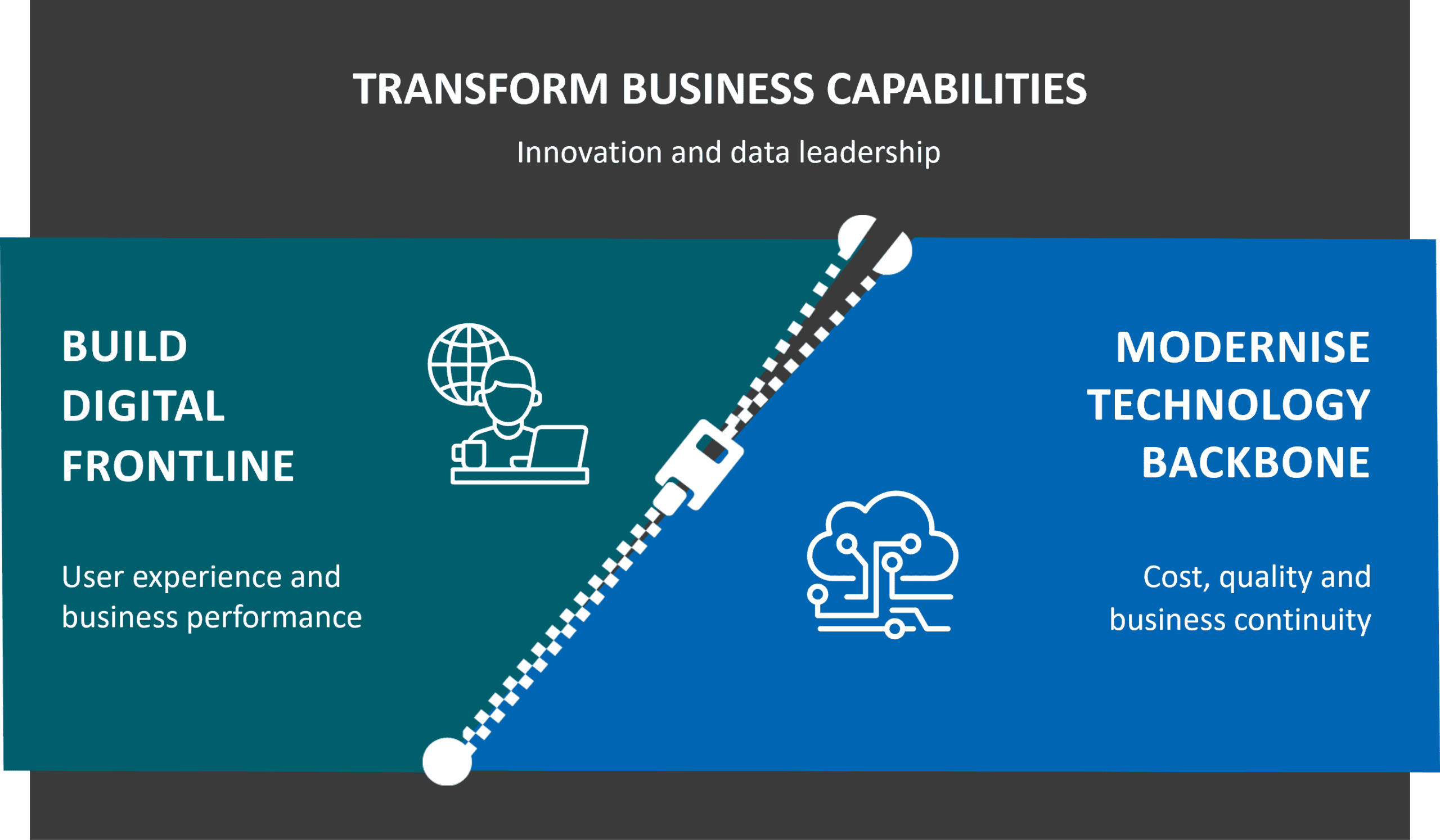
Enterprise Architecture is the practice that defines how business capabilities, processes, data, solutions, platforms and ecosystems need to evolve to support the organisation’s long-term goals. It ensures structural fit between business priorities and the business technology landscape in a continuously changing environment.
Enterprise Architecture responds to the enterprise mission, vision and strategy. It addresses structural change arising from strategic priorities, mergers and acquisitions, organisational restructuring, ecosystem evolution, regulatory developments and technology renewal. Its purpose is to maintain flexibility and coherence while guiding the organisation from its current state towards defined target states.
Enterprise Architecture gives demand structural quality. It ensures that demand is not shaped only by individual needs, local optimisation or short-term delivery pressure, but by a coherent view of how business capabilities should develop over time. This becomes more important as AI agents start to carry business logic across applications, while traditional applications increasingly act as systems of record for data, transactions, controls and auditability.
Enterprise Architecture operates through capability planning. It defines business capabilities, including processes, data, information technology solutions and overarching ecosystems. It establishes domain-specific roadmaps that describe the structured transition from current state to target state.
These roadmaps form the basis for portfolio steering and programme execution. Development initiatives are derived from roadmap priorities and introduced into portfolio governance structures. Enterprise Architecture supports projects and major agile developments by ensuring that implementation decisions remain aligned with architectural principles, target states and cross-domain dependencies.
Architecture principles define favoured solution platforms and guiding standards for development request evaluation. Enterprise Architecture ensures data and process consistency in accordance with mandatory governance practices.
Enterprise Architecture encompasses business, information, application and technology architectures in alignment with business direction and business objectives. The Business Technology Standard defines a core architecture complemented by domain-specific architectures. A business ecosystem layer provides the structural context for integration beyond organisational boundaries.
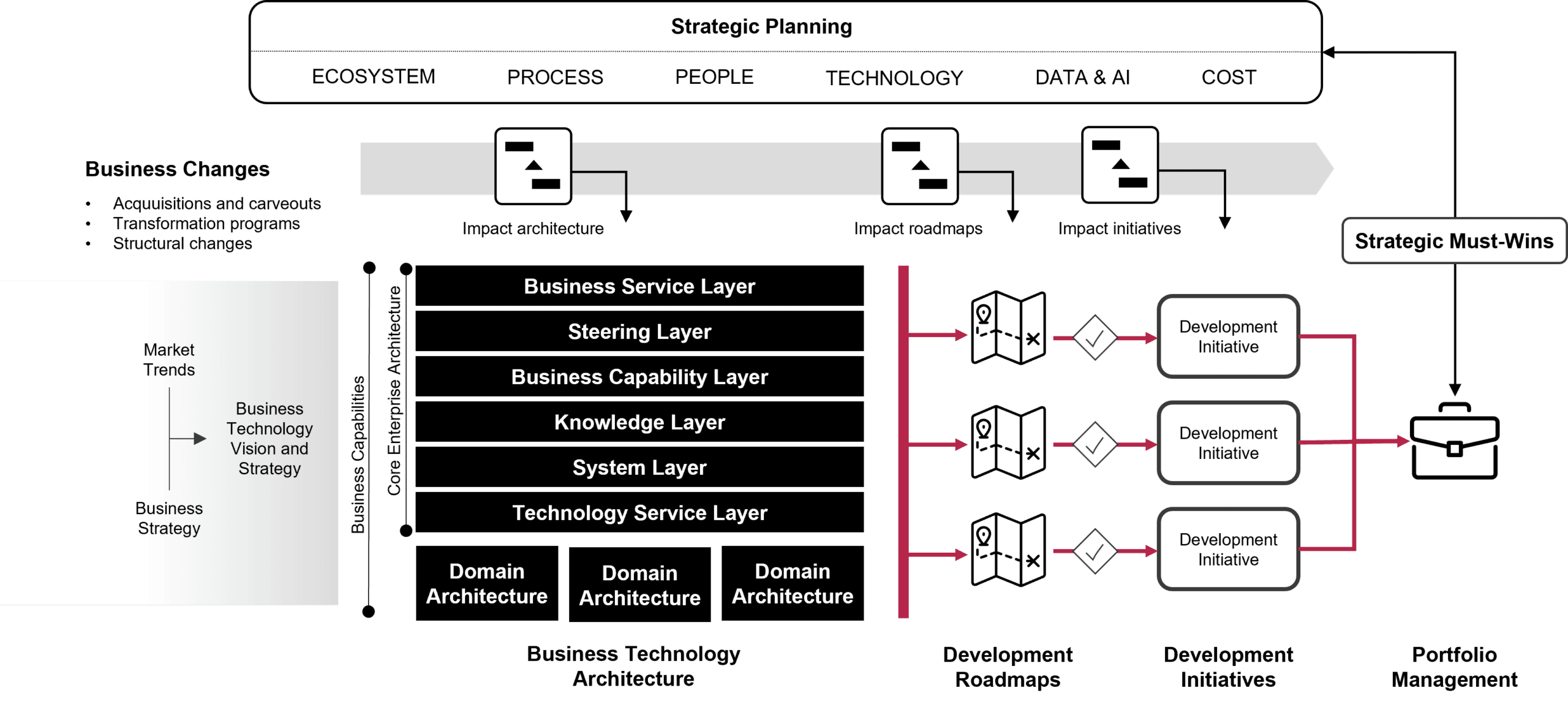
The architecture model is modular. Tightly interconnected business solutions form separate solution domain entities. Each domain contains common elements and shared guidelines referred to as the core architecture. Organisations typically maintain several solution domains to enable flexibility while preserving structural coherence.
Enterprise Architecture planning addresses both internal capability development and external interfaces with ecosystem participants. It ensures that business capabilities are supported by coherent data structures and technology platforms, while enabling controlled integration with customers, partners and vendors.
AI agents add a new architectural layer to this landscape. Enterprise Architecture must define how cross-application agent processes are enabled, which business logic may reside in agents, what remains controlled by systems of record, and how actions are logged, supervised and escalated. Common standards for identity, access, interfaces, context sharing, monitoring, testing and lifecycle management are needed to ensure that AI agents remain interoperable, reusable and reliable across the application landscape.
Business ecosystem architecture defines how the organisation integrates with customer ecosystems, partner ecosystems and vendor ecosystems. The objective is not to document every relationship in detail, but to provide enough structure to manage dependencies, enable integration and preserve long-term flexibility.
Enterprise Architecture provides a structured view of business technology capabilities through processes, information systems, data, data flows, technologies and ecosystems. This structural view is essential, but it is not sufficient on its own.
Human-centred planning complements Enterprise Architecture by adding an outside-in perspective. It brings user expectations, experiences, skills and behaviours into capability planning, ensuring that demand is shaped with a clear understanding of both business capability needs and user perspectives.
Human-centred planning is carried out within value streams through planning collectives. It is intended for those responsible for developing business operations and services, such as Business Capability Owners. This ensures that capability planning is not only structurally coherent, but also grounded in how people, customers and users experience the capability in practice.
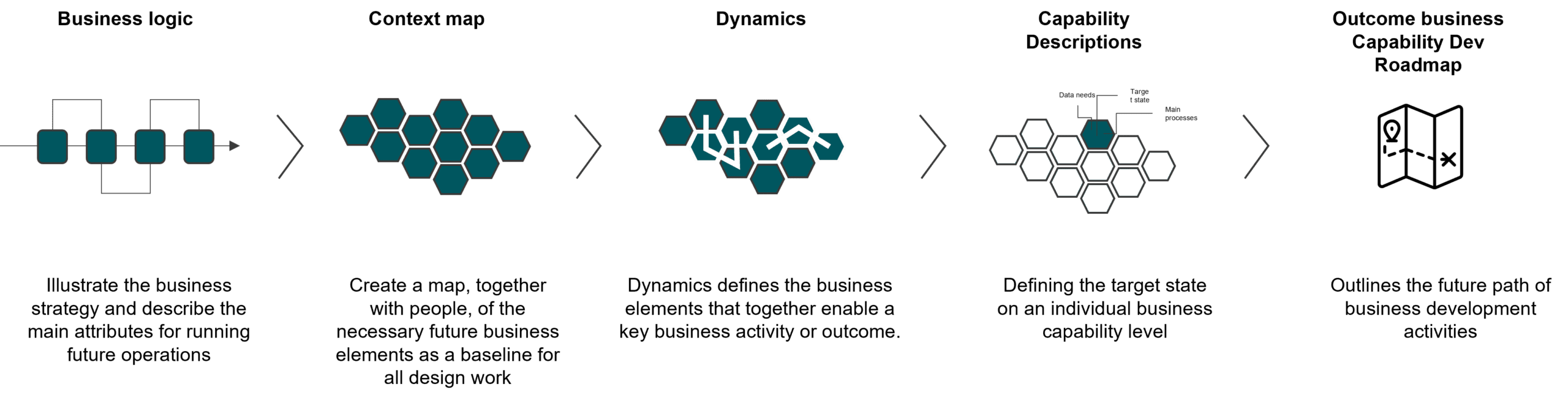
The practice begins with business capability planning. This is a semi-formal and intuitive activity that creates a visual representation of the key elements of a business capability. It brings together structural and human elements, their interconnections, and the overall development vision. The outcome enables stakeholders to form a shared understanding of the capability, identify key development topics and prepare a coherent development roadmap.
A second key aspect is user journey design. This provides an outside-in counterpart to traditional procedural design. User journeys describe how users or customers experience services and interactions, helping to identify pain points, expectations and opportunities for improvement. This perspective strengthens the design of services and business technology solutions by ensuring they are aligned with real user needs.
Organisations that apply human-centred planning consistently are better positioned to deliver improved user and customer experiences. This can provide a meaningful and sustainable competitive advantage.
Enterprise Architecture operates through defined governance structures and active participation in development to ensure alignment with agreed target states.
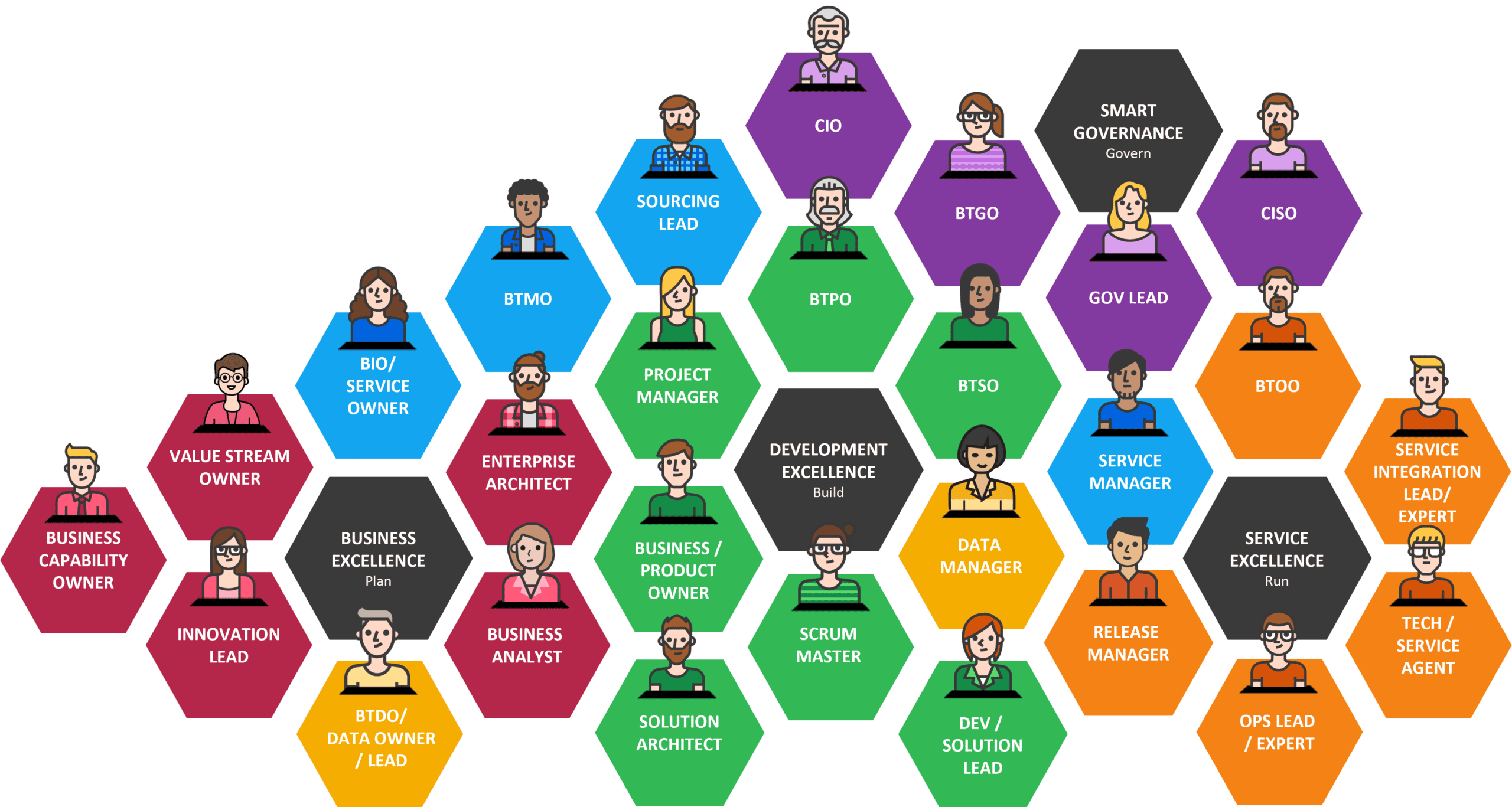
The Chief Enterprise Architect owns the capability and is accountable for architectural principles, target states and overall architectural governance. The Enterprise Architect supports capability planning, domain roadmaps, development initiatives and portfolio decisions by ensuring that planned demand remains aligned with architecture principles, target states and cross-domain dependencies.
Business technology debt arises when business technology solutions gradually lose their ability to support business priorities effectively. They become slower to change, more costly to maintain and less responsive to new business needs.
This does not result from a single incorrect decision. It develops over time when investment decisions, development priorities, governance arrangements and technology choices are not consistently aligned with long-term business direction. While each decision may appear reasonable at the time, together they can create a widening gap between business expectations and the capability of business technology solutions.
Enterprise architecture prevents this erosion by maintaining clear alignment between business objectives and solution evolution. It ensures that ambition is matched with realistic investment levels, delivery capacity and architectural constraints. When objectives exceed what current structures can sustain, enterprise architecture makes this visible early, enabling leadership to adjust scope, funding or sequencing before structural constraints accumulate.
In practice, enterprise architecture makes structural debt visible in a systematic manner. Regular debt analysis describes the nature, scale and business impact of identified gaps in key solutions, platforms, integrations or data structures.
These analyses form the basis for structured decision-making in portfolio and governance forums. Based on agreed priorities, enterprise architecture defines architectural guidelines and lifecycle directions and supports programmes and projects in implementing corrective actions.
Enterprise architecture also ensures that governance supports coherent solution development. It clarifies decision authority, aligns priorities with portfolio management and applies consistent architectural principles across development phases. Deviations require explicit review and approval, ensuring that individual programmes and projects do not introduce fragmentation or long-term structural risk.
Through this structured oversight, enterprise architecture safeguards long-term coherence between business direction and the supporting technology landscape. It ensures that cumulative development decisions strengthen rather than weaken the organisation’s ability to execute its business direction.