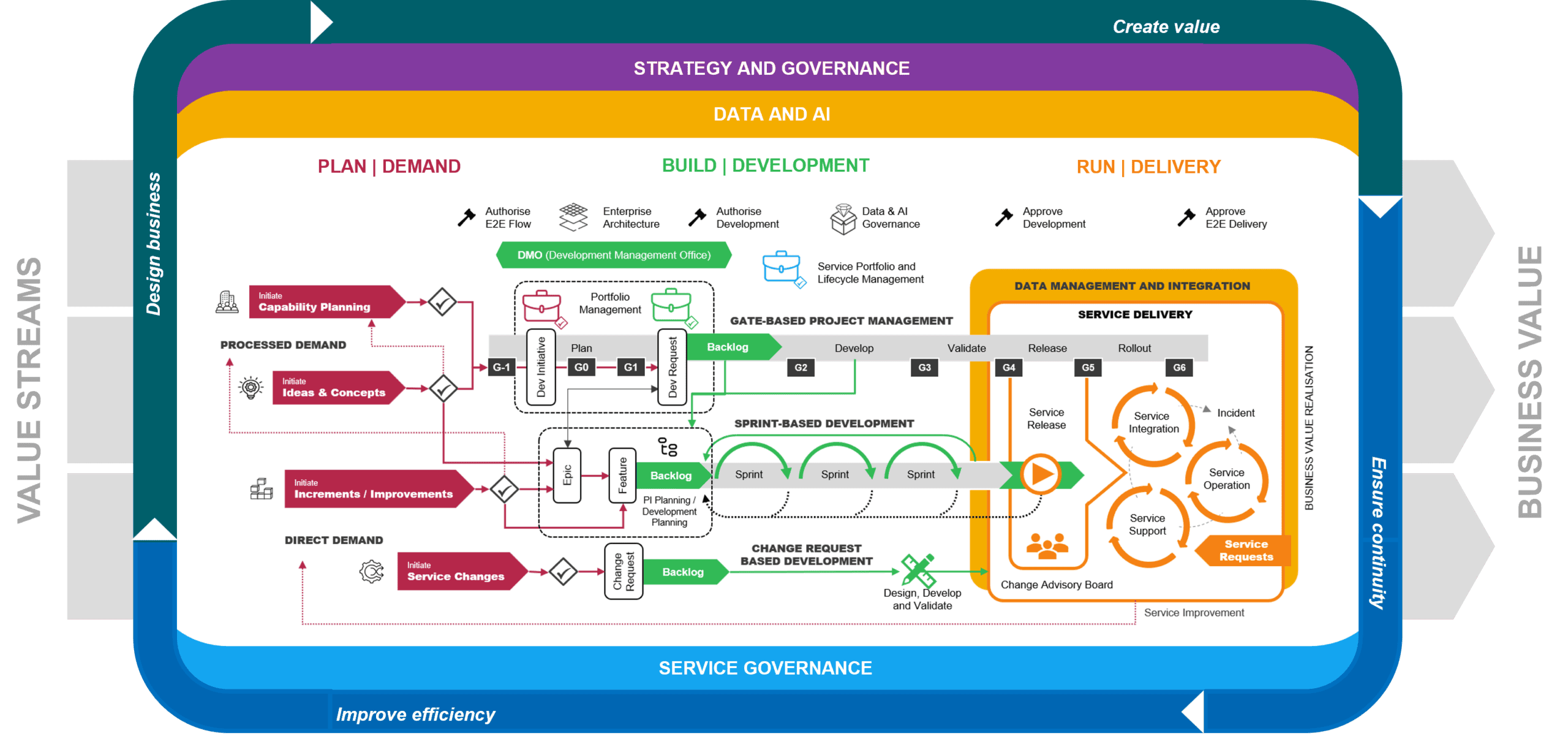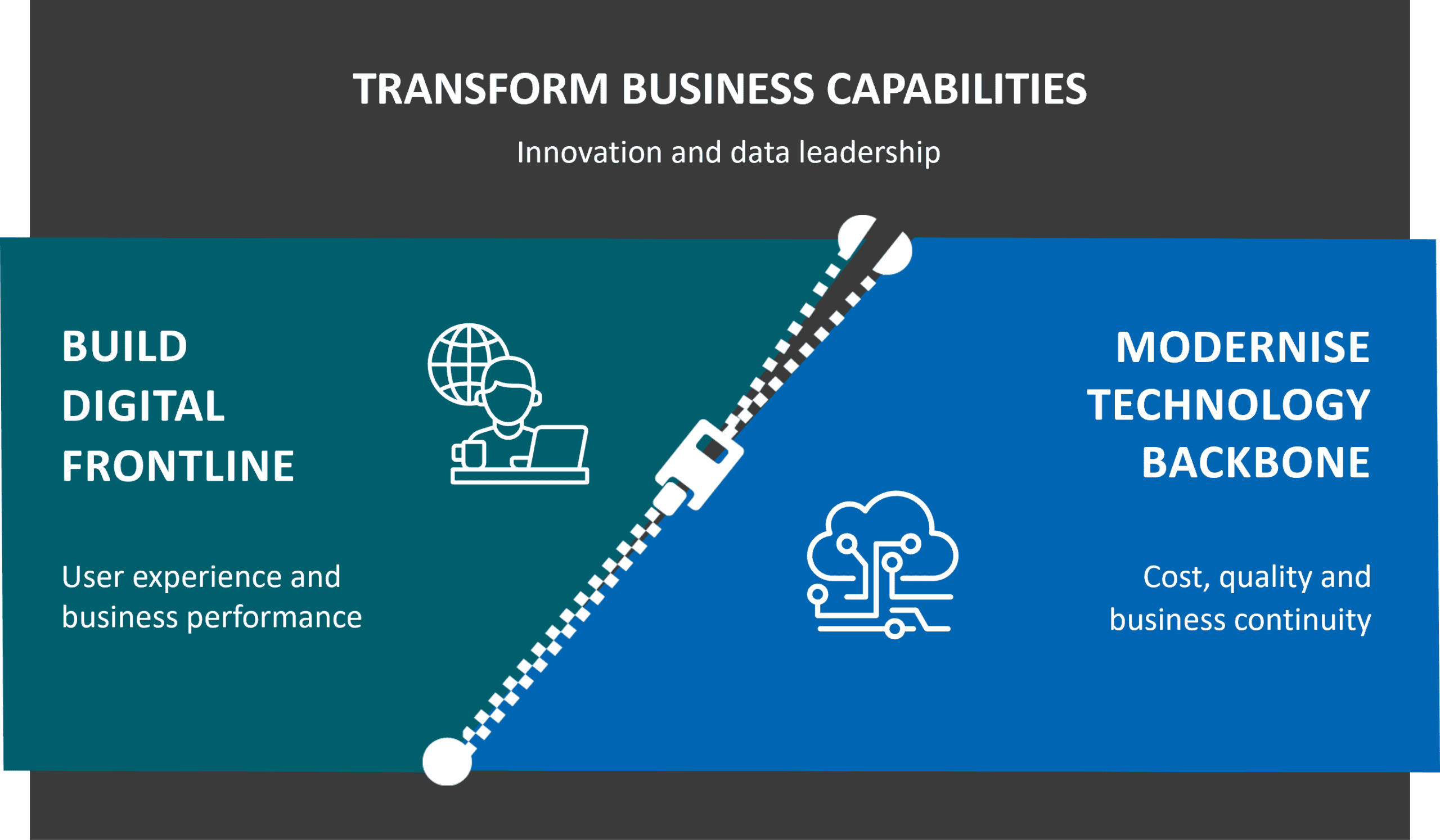
The demand discipline ensures that business capability development and technology solution development operate as one connected flow. The two cannot be managed separately because business change and technology change continuously shape and depend on each other. Business capabilities define what the organisation needs to become better at, while technology solutions provide the digital, data, AI and service capabilities that make the change possible in practice.
These two forms of development have always been interconnected. In many organisations, however, the connection has been too linear. Business and technology teams develop different elements of the solution, such as people, processes, technology and data, and rely on handovers and later coordination to bring them together. This creates a risk that solutions are delivered without enough business capability context, or that business plans are created without enough understanding of technology possibilities and constraints.
The role of the demand discipline is to make this connection cross-integrated. Business capability development and technology solution development need to shape each other from the beginning. Business needs must be understood in the context of architecture, services, data, AI, continuity, portfolio capacity and operational reality. Technology possibilities must be evaluated through business value, operating model impact and service use.
The Demand discipline does this through two connected but distinct activities: demand planning and demand management. Demand planning shapes what needs to change, why it matters and what kind of business capability or service outcome is expected. Demand management organises approved demand into executable development work without losing the business intent.
Together, demand planning and demand management create the front end of value creation. They ensure that development starts from a clear business rationale, moves through the right level of planning and governance, and enters development in a form that technology solution teams can commit to and deliver.
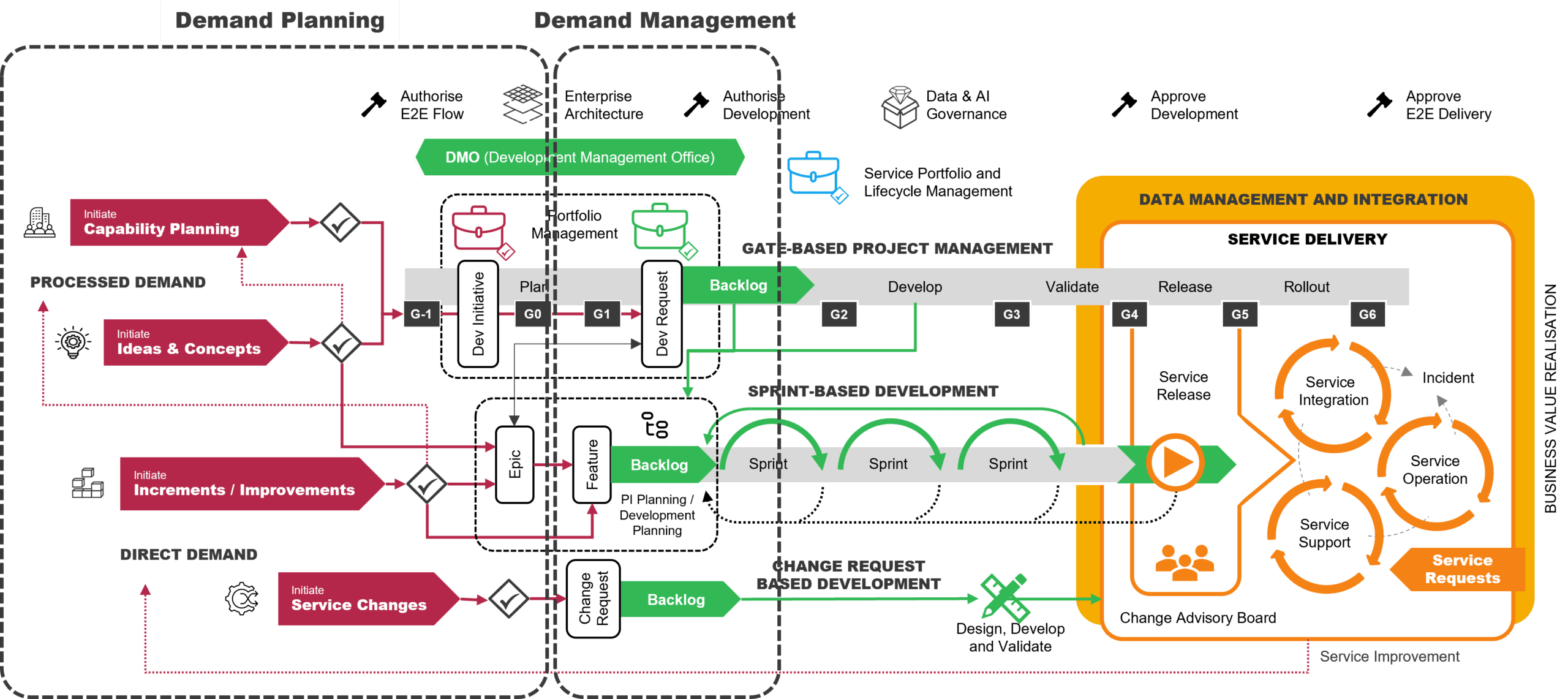
A central principle of the demand discipline is the clear separation between demand planning and demand management.
Demand planning is a business-led activity that focuses on understanding what needs to change and why. Enterprise architecture supports this upfront work by helping shape future business capabilities, services, data, AI-enabled capabilities and products through business design. The outcome of demand planning is a clear view of upcoming development in the form of roadmaps, development initiatives and development requests. This work takes place before delivery commitments are made and provides the basis for informed investment and prioritisation decisions.
Demand management builds on this foundation. Its role is to organise and plan solution development. It turns sufficiently planned development outcomes, including those authorised through development requests, into structured commitments and backlogs for delivery. Demand management focuses on sequencing, capacity, dependencies and flow efficiency, without redefining the original business intent unless this is necessary.
The development request acts as the handshake between these two activities. It translates business capability development into a form that technology solution development can commit to. When demand planning is done properly, demand management can focus on efficient execution. When it is weak or skipped, delivery teams are forced to compensate by making business design decisions under time pressure.
Demand must not move through one generic path. Different types of demand require different levels of business design, validation, governance and delivery preparation. If all demand is treated the same way, large changes are under-planned and small changes are slowed down by unnecessary governance.
The demand discipline distinguishes four development demand types.
Capability planning is used when the organisation needs to develop or transform a business capability. It requires deeper business design, architectural alignment, roadmap planning and portfolio decisions before development is committed.
Ideas and concepts are used when the opportunity is still uncertain. They provide a fast and controlled path to explore, simulate, prototype and validate whether an idea has enough business potential to become a development initiative or move into further planning.
Increments and improvements are used when existing services, products or solutions need to be enhanced. These demands can often move faster into backlog-based development when ownership, value, scope and dependencies are clear.
Service changes are used when existing services need controlled modification, extension or correction. They require enough governance to protect service stability, continuity and user impact, but should not be forced through the same path as major capability development.
These paths allow the organisation to balance focus and speed. Larger and more uncertain needs receive the planning and governance they require, while smaller and clearer needs can move through lighter paths. At the same time, the organisation maintains visibility over where effort, capacity and investment are going.
The demand discipline combines several management views into one coherent capability for shaping and controlling development demand.
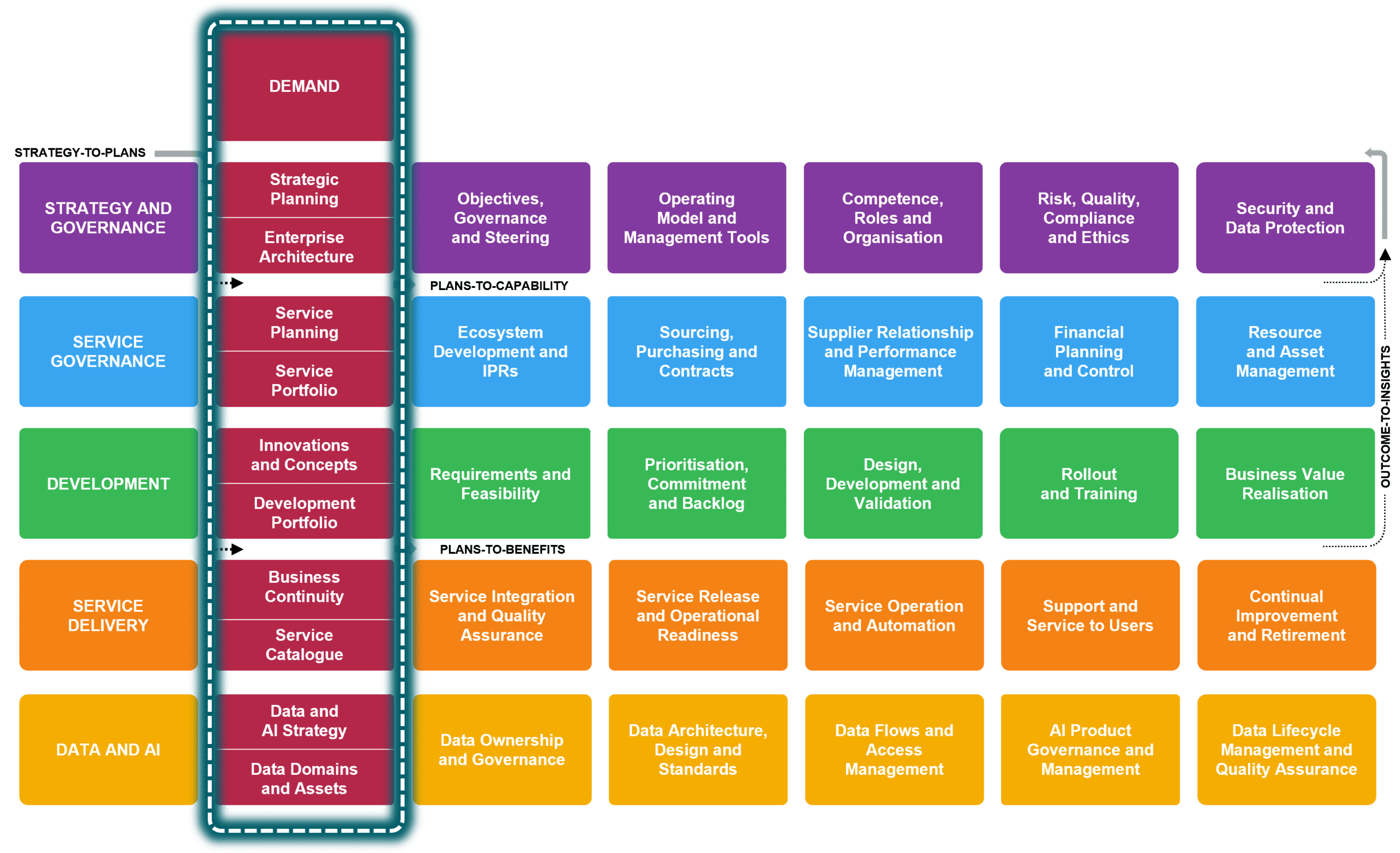
Strategic planning defines the business direction and priorities that guide demand. It translates business ambition into strategic must-wins, planning focus and direction for value streams and planning collectives. Artificial intelligence makes this planning more important because it changes knowledge work, productivity assumptions, service concepts and the speed at which capabilities can be tested and scaled.
Enterprise architecture gives demand structural quality. It defines how business capabilities, processes, data, solutions, platforms and ecosystems should evolve from current state towards target states. As AI agents start to carry business logic across applications, enterprise architecture also defines how cross-application agent processes are enabled, how systems of record remain authoritative and how interoperability, quality and lifecycle control are maintained.
Service planning ensures that each individual service remains purposeful, economically justified and aligned with business priorities. It defines why the service exists, how it is governed and funded, how it is operated and how it evolves over time. Service portfolio provides the management view across services, showing how current, planned and retiring services affect the overall service landscape, investment priorities and operational commitments.
Innovations and concepts provide a controlled but fast-moving path from early ideas to validated concepts. This capability is especially important when needs are unclear, novel or exploratory. AI strengthens the practice by making experimentation more incremental to business capability planning and solution planning through simulations, rapid prototypes, process analysis and data-driven validation.
Development portfolio governs how planned demand is prioritised, sequenced and resourced for execution. It ensures that development initiatives and development requests align with business priorities, available capacity, dependencies and value realisation expectations. As AI accelerates business design and solution planning, portfolio discipline becomes more important because more ideas can become development candidates faster.
Business continuity ensures that operational resilience and business criticality are considered in development and service decisions. It safeguards essential business operations by ensuring that changes do not compromise availability, recovery capability or compliance obligations. This includes dependencies on global cloud platforms, ecosystem partners, automation and AI-enabled operational capabilities.
Service catalogue defines what services, service requests, AI agents and AI-enabled products are available to users. It channels routine needs into predictable fulfilment paths and protects delivery capacity. As AI agents and products are created and released rapidly, catalogue management must become more automated or semi-automated so that approved capabilities remain visible, consumable and controlled.
Data and AI strategy defines where data and AI are expected to create business value and how this is achieved in a controlled and sustainable way. Data domains and assets provide the structure for ownership, accountability, reuse and investment. This is increasingly important because AI makes weaknesses in data quality, ownership, access control and process discipline directly visible in recommendations, automated actions, customer interactions and operational outcomes.
Demand planning has too often been treated as an activity that is mobilised for major transformations, strategy programmes or consulting-led design exercises. This may produce useful results for individual initiatives, but it does not build the organisation’s own capability to continuously shape business change. As a result, business needs may still enter development too late, too narrowly defined, or without enough clarity on capability impact, value rationale, user perspective or operating model implications.
The organisation should therefore invest in demand planning as its own professional capability. Business stakeholders need practical and intuitive methods for shaping capabilities, services, data, AI-enabled work, user journeys and value cases. These practices cannot be too technology-led, too dependent on specialist facilitation, or inherited from consulting approaches that are difficult to apply in continuous business development.
When demand planning is weak, the organisation becomes too demand management driven. Work can still be refined, sequenced and delivered, but the business capability context may remain underdeveloped. This creates a gap between what the business needs to become better at and what technology solution development is asked to deliver.
The organisation’s ability to succeed with business technology depends on how well business capability development and technology solution development are cross-integrated. Demand planning makes business ambition actionable. Demand management ensures that prepared demand flows efficiently into development and services without losing its business intent.
The demand discipline therefore creates the front end of value creation. It ensures that business capability development and technology solution development do not operate as separate worlds connected mainly by requests and handovers, but one cross-integrated flow from business ambition to operational capability, service use and realised value.