Development is the discipline that turns business intent into operational business capability and measurable business value. It connects business needs, solution design, implementation, rollout, adoption, and value realisation into one coherent development flow.
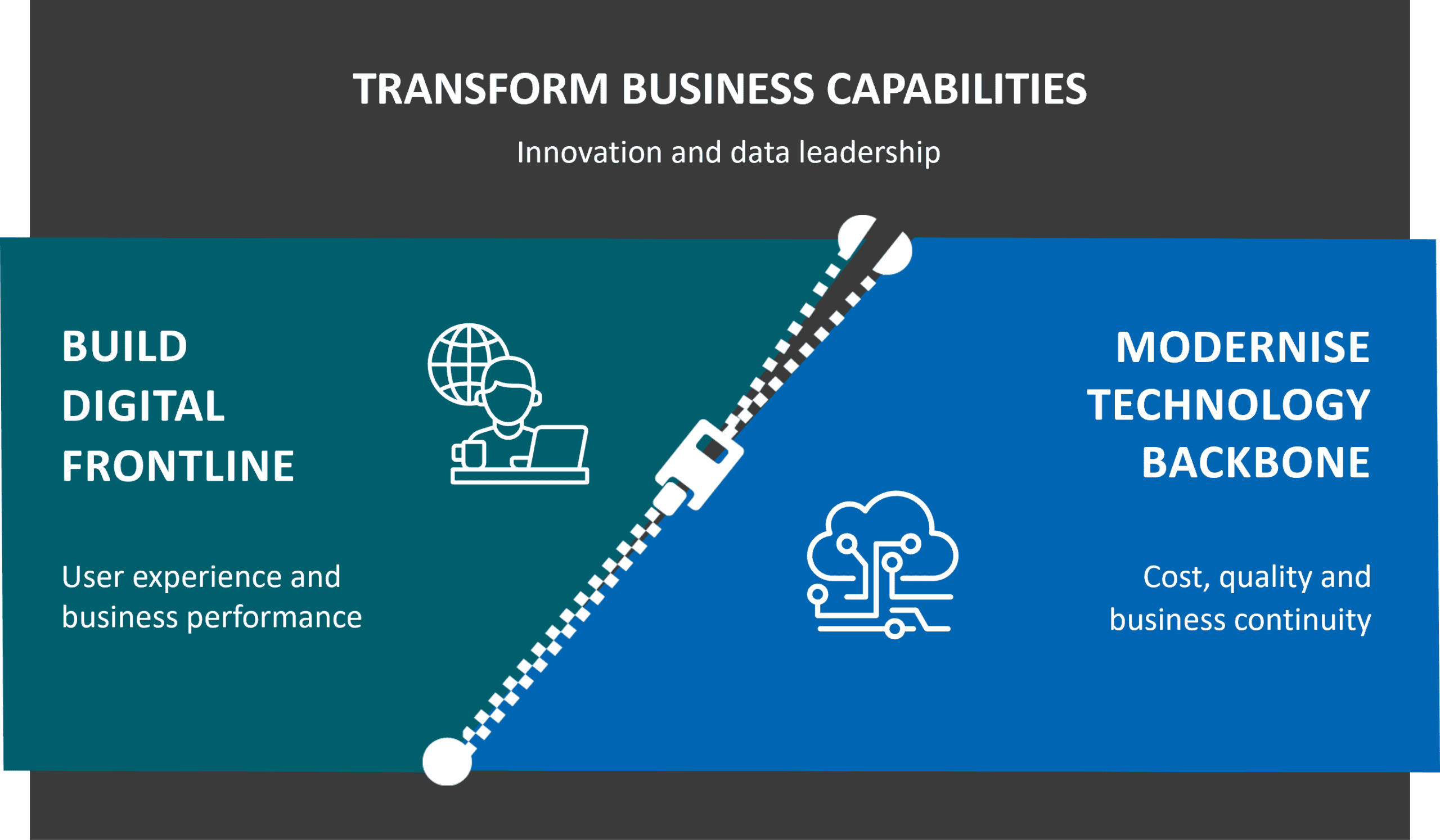
Development is a business capability as much as a delivery capability. It brings together business ownership, operational understanding, technology capability, data, partners, and governance to create solutions that work in real business environments. The objective is to strengthen how the organisation operates, serves customers, uses information, and improves performance over time.
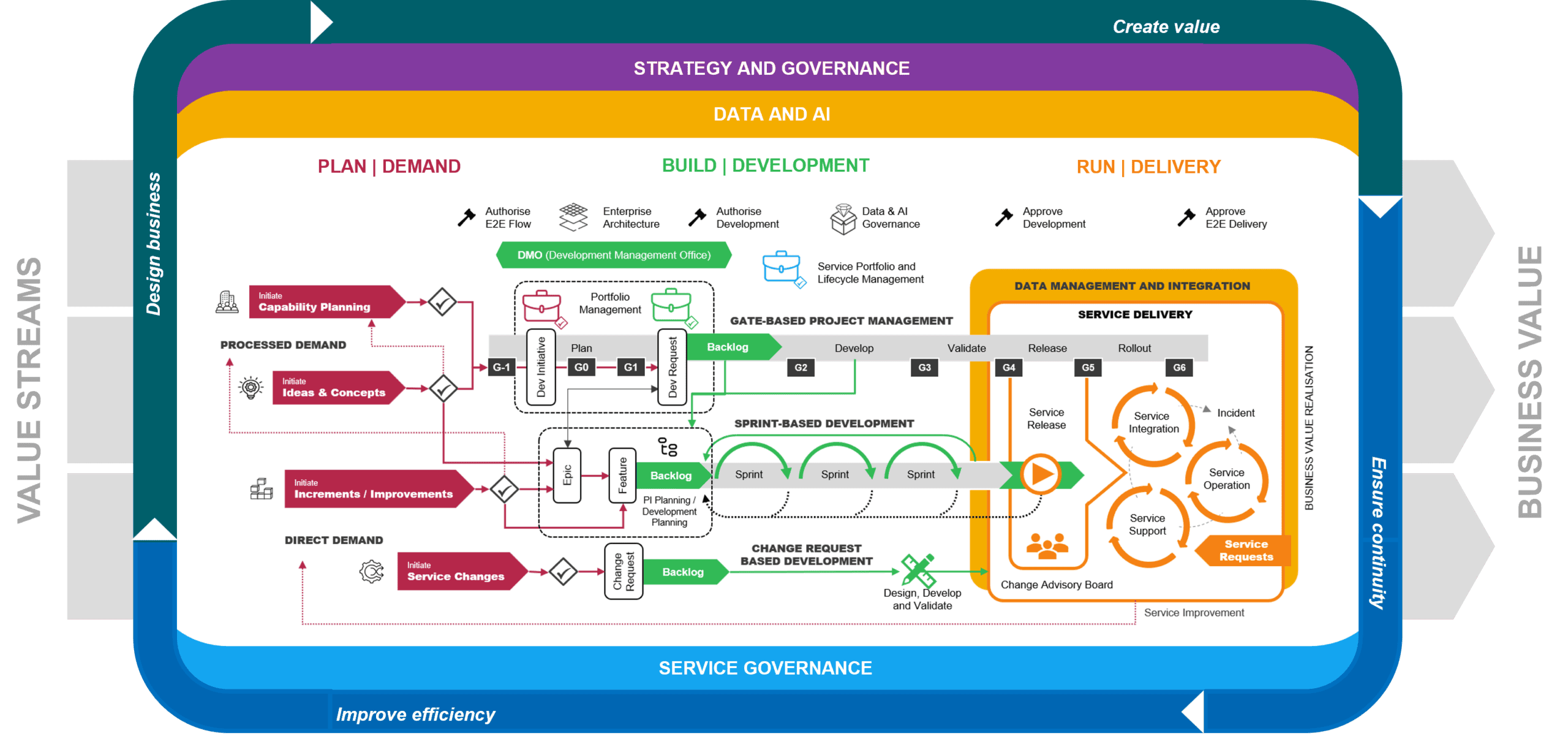
Development begins as business intent takes shape through demand planning, innovations and concepts, capability planning, and portfolio steering. These activities prepare development by clarifying what needs to change, why the change matters, and what level of investment and organisational commitment is justified.

The demand and development disciplines are therefore closely connected. Innovations and concepts, development initiatives, development requests, and portfolio steering form the bridge between planning and execution. They ensure that development work is grounded in business priorities before implementation capacity is committed.
Development continues this flow by turning validated intent into solutions that can be implemented, operated, adopted, and improved. This requires more than delivery execution. It requires shared ownership of business outcomes, realistic feasibility, disciplined prioritisation, sound solution design, operational readiness, and active value realisation.
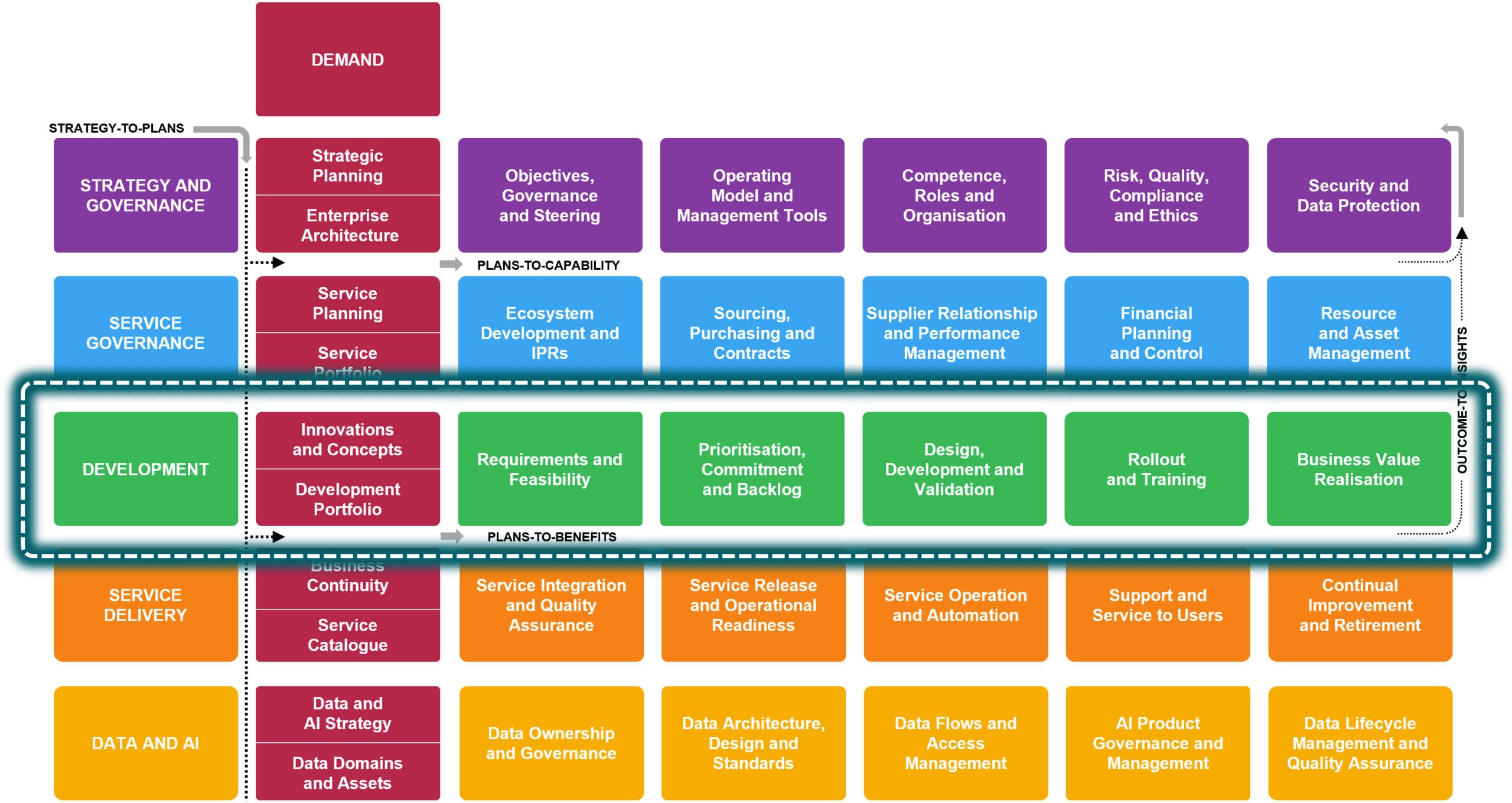
Development covers the progression from requirements and feasibility to prioritisation, commitment, design, development, validation, rollout, training, and business value realisation.
Each part of the flow has a distinct purpose. Requirements and feasibility ensure that the business need is real and the planned solution is realistic. Prioritisation and commitment ensure that scarce development capacity is directed towards the most valuable work. Design, development, and validation turn committed work into a releasable solution. Rollout and training introduce the capability into operational use. Business value realisation confirms that the organisation achieves the intended outcomes in practice.
The flow is not a rigid sequence. Understanding improves during development, assumptions are validated, and priorities change as business conditions evolve. Development must therefore combine discipline with adaptability. It needs enough governance to protect value and manage risk, and enough flexibility to learn, adjust, and improve.
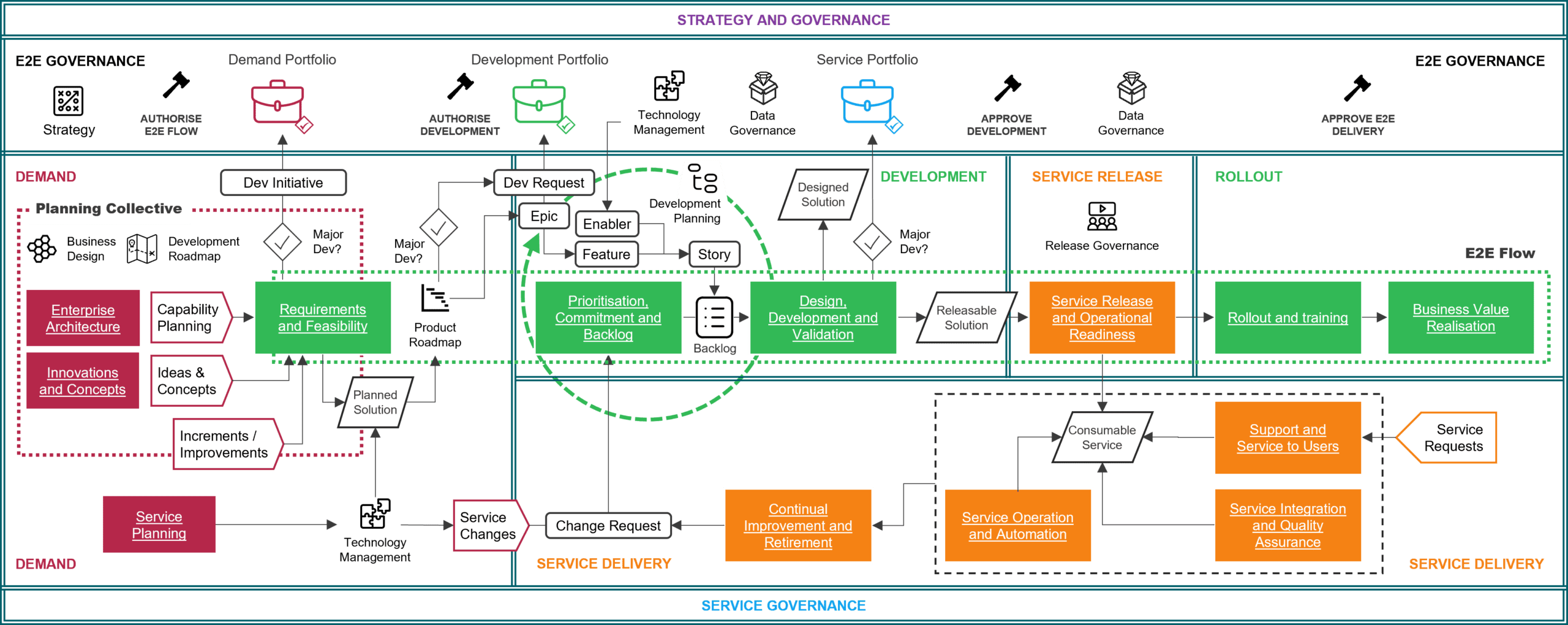
Different development practices support different types of business and implementation needs.
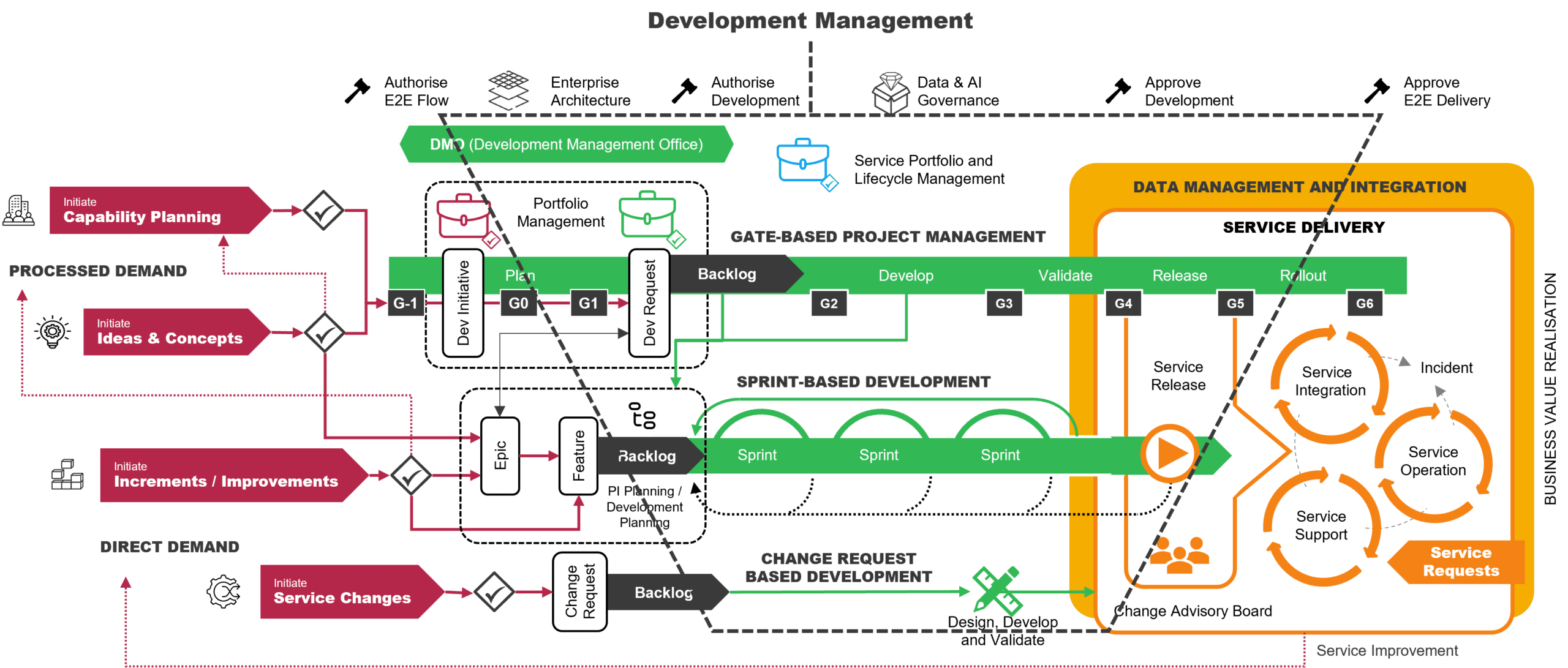
Gate-based development provides strong governance for significant investments, broad stakeholder alignment, dependency management, and major business change. It supports clear decision points and controlled commitment when the scale, risk, or organisational impact of development requires formal steering.
Sprint-based development supports rapid learning, iterative refinement, early validation, and continuous feedback. It is well suited to development where the solution can be shaped through testable increments, user input, and evolving understanding.
These practices can be combined within the same end-to-end flow when each retains its own discipline. Gate-based development keeps clear approval points and investment control. Sprint-based development keeps short iterations, testable increments, and regular feedback. Together they enable controlled and responsive development without turning governance or agile delivery into diluted versions of either practice.
Backlog-driven execution supports both approaches. Projects use backlogs to coordinate implementation work, dependencies, and agile development teams, while sprint-based development uses backlogs to refine and deliver increments. This creates a common mechanism for planning, visibility, and execution across development methods.
Artificial intelligence changes the speed, shape, and participation model of development. Solution development becomes more descriptive, simulative, and feedback-driven. Business needs can be explored through prototypes, scenarios, simulations, and rapid refinement before and during implementation.
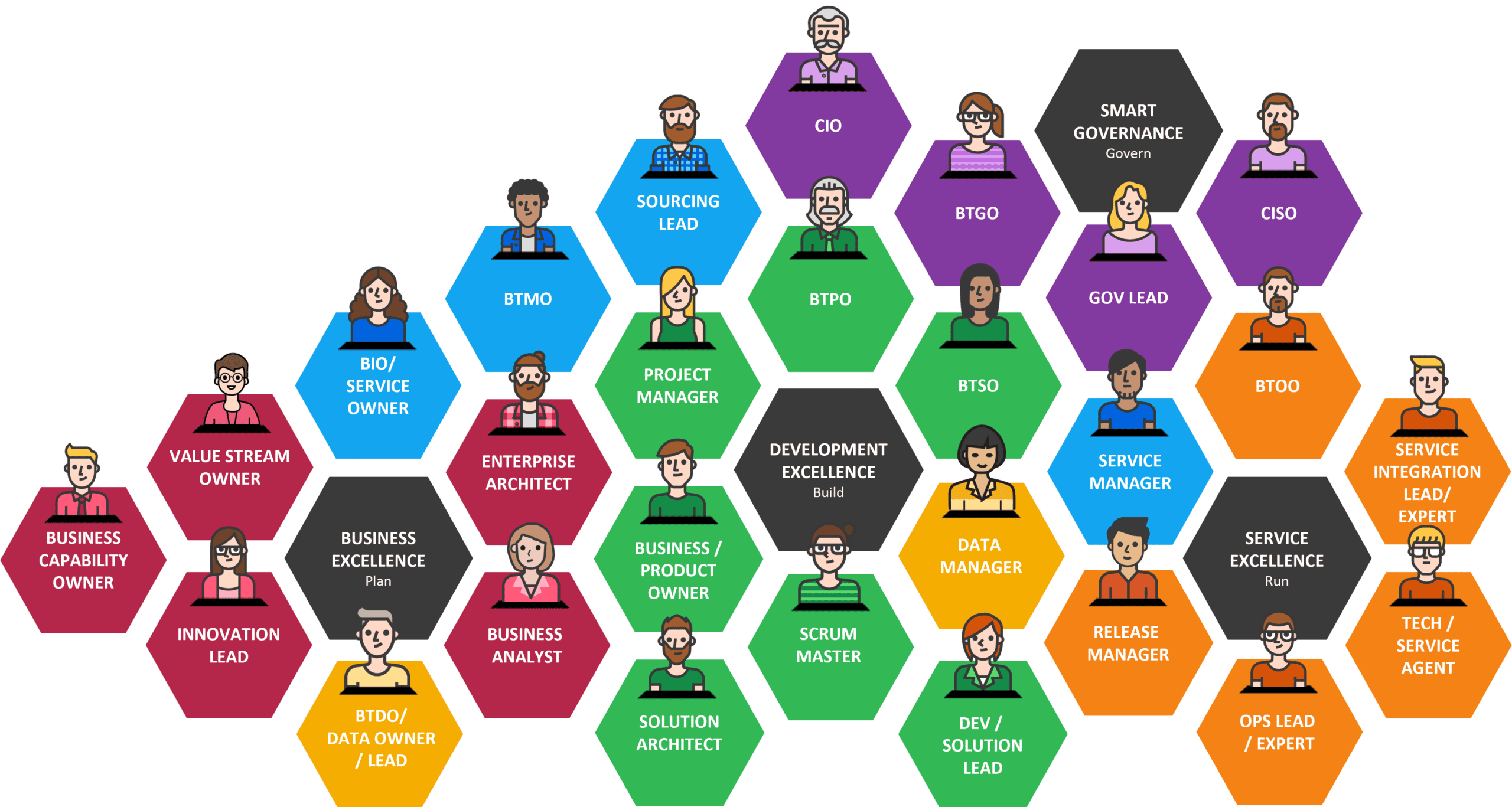
This gives business technology stakeholders a larger role in development. People who understand business operations, data, processes, services, and technology can shape working solutions more directly with the support of AI, platforms, and development teams. Business understanding and operational judgement become more important, not less.
At the same time, AI raises the demands for validation and governance. AI-enabled solutions depend on data quality, appropriate usage context, effective oversight, and trust. Their behaviour must remain aligned with business objectives, operational requirements, security policies, ethical principles, and risk boundaries. While AI accelerates development, it also increases the need for disciplined prioritisation, human guidance, operational readiness, and continuous monitoring.
The Development discipline is structured around five connected capabilities.
Requirements and feasibility translate business intent into development-ready direction and confirm that the expected value, solution direction, organisational readiness, and implementation capability are realistic.
Prioritisation, commitment, and backlog management decide what moves forward, when capacity is committed, and how development work is refined into executable items.
Design, development, and validation turn committed work into solutions that are usable, reliable, secure, operationally ready, and aligned with business expectations.
Rollout and training introduce new capabilities into operational use through release readiness, business rollout, adoption support, training, and operational learning.
Business value realisation ensures that developed capabilities deliver measurable outcomes in practice and continue to evolve through feedback, optimisation, and lifecycle improvement.