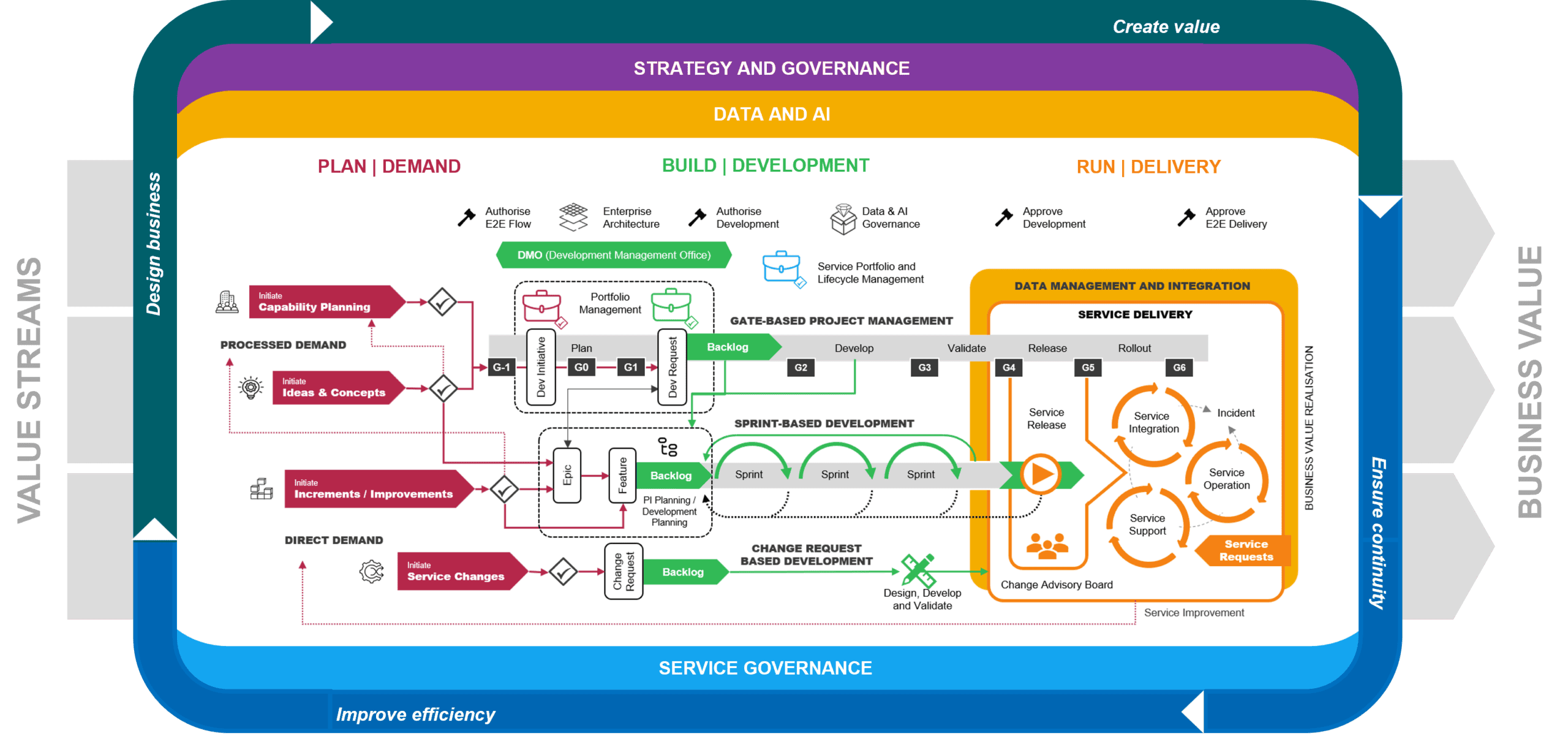
Strategy and Governance give business technology its direction and control. The discipline ensures that business technology is not managed as separate initiatives, services, technologies, or control processes, but as one coherent capability for value creation.
The Strategy and Governance discipline starts from business ambition. It clarifies what the organisation aims to achieve and how business technology must evolve to support those aims. This direction is then translated into objectives, governance structures, operating model practices, roles, architectural guidance, risk management, security, and data protection.
The purpose is to make business technology both ambitious and governable. Organisations need speed, innovation, and responsiveness, but they also need coherence, accountability, resilience, and trust. Strategy and Governance provide the management discipline that keeps these needs in balance.
Business technology creates value when decisions remain aligned with business strategy and priorities and work coherently across the organisation. A service should remain purposeful and economically justified. Data and AI capabilities should strengthen business outcomes rather than create isolated experiments. Enterprise architecture provides direction and helps maintain long-term coherence, while governance ensures that decisions remain aligned, risks are understood and structural debt is controlled.
The purpose of governance is not bureaucracy. It is to ensure that decisions are made consciously, at the right level, and with clear accountability. Good governance enables speed and flow while preventing fragmentation, duplicated investments, uncontrolled risks, and gradual erosion of business technology capability.
Strategic planning defines the direction for business technology. It translates business ambition into strategic must-wins, objectives, planning focus, and value stream direction. It gives the organisation a shared view of what matters most and where business technology effort should be concentrated.
Strategic planning is not a separate planning exercise that ends before execution begins. It is a continuous governance capability. It keeps business technology aligned as business priorities, market conditions, regulation, ecosystems, data opportunities, and AI capabilities change.
Enterprise architecture turns this direction into structural coherence. It defines how business capabilities should evolve and how processes, data, solutions, platforms, and ecosystems fit together. It helps the organisation move from current state towards target states without losing long-term flexibility.
Enterprise architecture also protects the organisation from business technology debt. Individual decisions may appear reasonable in isolation, but over time they can create complexity, duplication, cost, and limited adaptability. Enterprise architecture makes these structural effects visible and ensures that development decisions strengthen the organisation’s ability to execute its business direction.
Strategic planning and enterprise architecture are closely connected with the demand discipline. They shape roadmaps, planning collectives, development initiatives, and demand priorities. In strategy and governance, they are treated as integral governance capabilities because they define the direction and structural logic that guide all business technology development.
Governance ensures that direction becomes coordinated action. It defines how decisions are made, who has authority, how priorities are steered, and how business value is followed through.
The Business Technology Standard is based on Minimum Viable Governance. This means enough structure to align priorities, manage dependencies, and create synergies across value streams and end-to-end flows. It also means avoiding unnecessary control layers that slow down execution or weaken ownership.
This becomes especially important as organisations grow more interconnected. Business value often depends on several value streams, shared services, common platforms, data domains, supplier ecosystems, and operational dependencies. Without governance, each area may optimise locally while the organisation as a whole becomes more complex and less agile.
Objectives, governance and steering capability define how this works in practice. They explain how objectives are set, how governance levels operate, how steering connects enterprise and value stream decisions, and how business value realisation is followed through.
The operating model defines how business technology works in practice. It connects planning, development, and service operations into an end-to-end value creation flow. Business needs are shaped, developed, released, used, improved, and measured through this flow.
Operating model and management tools capability make the flow manageable. Integrated tools provide visibility from objectives and demand to development, releases, services, performance, and realised value. Increasingly, these tools also support the work itself through automation, AI agents, and digital workers.
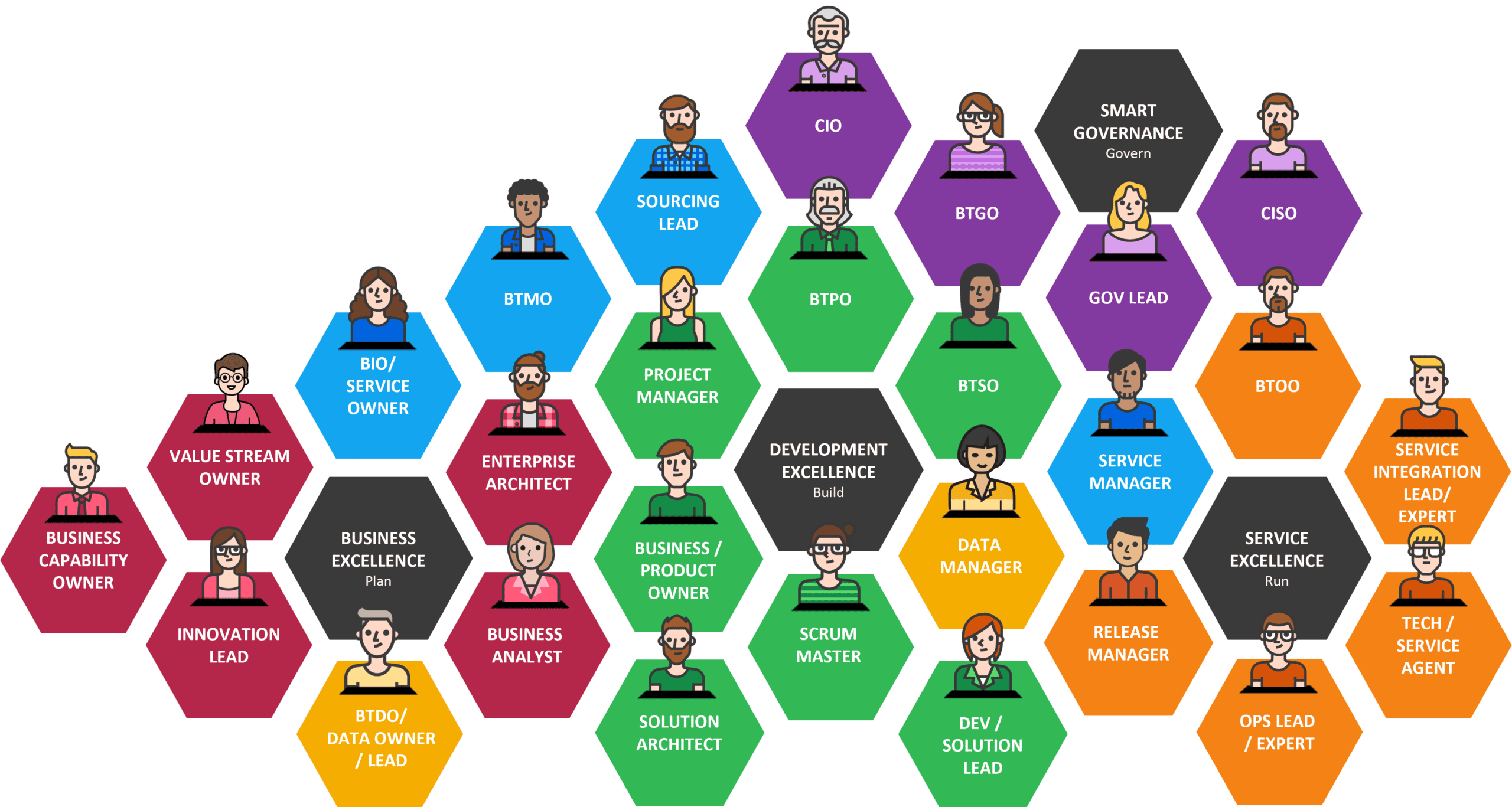
Competence, roles and organisation capability make the operating model live through people. Clear roles and governance entities define how work is carried out and how accountability is shared. Professional identities help people understand how they contribute to value creation and how different types of competence work together.
Artificial intelligence changes how competence is used. AI agents and digital workers can take on operational tasks, support knowledge work, and communicate with users across languages. This increases the importance of clear role knowledge, human judgement, supervision, and decision rights.
Business technology must be trusted to create value at scale. Risks, quality, compliance and ethics capability help the organisation make conscious decisions when opportunity and risk must be balanced. They ensure that quality, continuity, compliance, and responsibility are considered as part of normal business technology work.
Security and data protection protect the foundations on which digital business depends. Information, identities, data, services, and automated operations must be protected in a way that enables business use rather than blocks it. This is increasingly important as organisations rely on cloud platforms, ecosystems, automation, AI agents, and digital workers.
As business technology becomes more integrated and automated, trust must be built into everyday work. Risk, quality, compliance, ethics, security, and data protection allow the organisation to move fast without losing control, resilience, or responsibility.
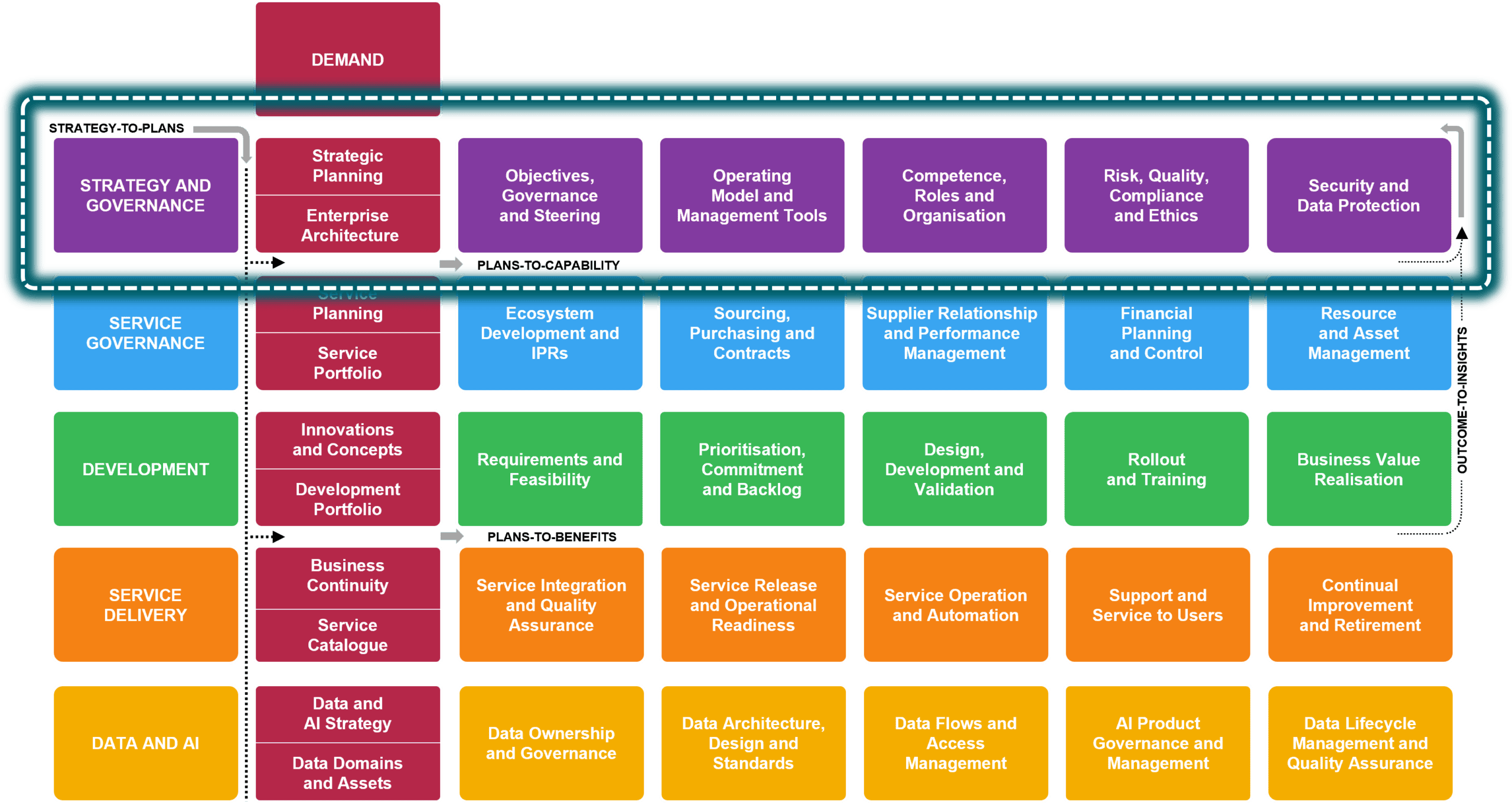
The capabilities of strategy and governance form one connected management discipline.
Strategic Planning provides direction. Enterprise architecture gives that direction structure. Objectives, governance and steering define how decisions are made and connected to business value.
Operating model and management tools define how business technology work is organised, governed, measured, and supported. Competence, roles and organisation ensure that people, roles, governance entities, and organisational structures make the operating model practical.
Risks, quality, compliance and ethics ensure that value creation the service ecosystem remain dependable and responsible. Security and data protection ensure that business technology, data, services, identities, and AI-enabled operations are protected and trusted.
Together, these capabilities ensure that business technology develops with clear direction, strong ownership, controlled risk, and measurable business value. Strategy and governance provide the foundation for business technology that is aligned, resilient, secure, responsible, and capable of continuous renewal.